Corporate Discipline and the Atomization of Labor
And Their Children After ThemCorporate discipline and the atomization of labor describe a workplace order in which control extends from the measurement of tasks into workers’ time, appearance, conduct, and relations with one another. Through Patrick Casati’s route for Districan, Hacine Bouali’s demolition work, and Anthony Casati’s factory shift, the novel contrasts individualized monitoring and pressure for productivity with the small routines and solidarities workers use to preserve some control over their days.
Measurement, Appearance, and the Districan Route
Patrick’s vending-machine job turns a service route into a system of recorded activity. At each machine he collects money, cleans the unit, and replenishes canned drinks, water, chips, small Papi Broussard cakes, and chocolate bars. A magnetic badge identifies each machine, and a scanner hanging from his belt records his visit. At home, he connects the device to his phone line, sending the information to Districan’s database. The same record supports route planning and invoicing, but it also lets the company measure work pace, identify downtime, and decide whom to dismiss as lazy. A routine that might otherwise remain largely unseen becomes legible to management as a sequence of measurable stops.
The job offers material security that makes its constraints more complicated than a simple account of exploitation. Patrick found it through Adecco, received an open-ended contract, earned just under seven thousand francs a month, and had a meal allowance, five weeks of paid vacation, and supplemental health coverage. Free Mars bars and Cokes were another perk. Yet the work’s monitored tempo and insistence on presentation disturbed him. He accepted the Districan shirt and jacket but refused the soft red company cap, arguing that it would not help him meet his quota and that no one could see him without it.
The cap converts an abstract demand for corporate identity into a recurring, material test of obedience. A quality-control supervisor repeatedly found Patrick bareheaded and pressed the point by invoking company rules and image. Afterward, Patrick wore the cap, felt watched, stamped on it, left it in his van, and lost it; across the wheel, workplace, bistro, office, and garage, the question of whether he should be wearing it followed him. Its importance is disproportionate to its practical function: that very disproportion shows how a minor instruction can make supervision present even outside the immediate encounter with a manager.
Work Without a Shared Industrial World
Patrick interprets the cap dispute against the disappearance of the older industrial workplace. In his account, mine explosions and silicosis belonged to an earlier world of conspicuous physical danger, while contemporary workers are worn down by humiliation, small demands, and petty surveillance. The factories have shut, and workers are left with scattered fragments of employment rather than a shared industrial identity. Work is increasingly organized through separate spaces—bubbles, cubicles, partitions, and glass panels—and through devices such as pagers and telephones that divide colleagues and weaken their connections.
This contrast is not simply between hard physical labor and easier service work. The new jobs are described as ill-paid and thankless, while their managerial language shifts toward relationships, service quality, communication, and client satisfaction. Workers are expected not only to supply punctual availability and labor that can be monetized, but also to believe in the organization’s mission and adopt its approved vocabulary. For Patrick, discipline thus reaches beyond the completion of a task: it asks for a performance of identification with the employer. The more work is divided into isolated roles, the harder it becomes to name a common interest or resist the rules individually.
The account also locates that change within a class hierarchy. Former industrial workers and their unions are treated as outdated, while demands for a decent life are recast as unreasonable obstacles to progress. The prospect of work moving to places such as the outskirts of Bucharest or being done by Chinese workers is presented as a ready-made justification for holding wages and expectations down. The language of global competition makes these constraints appear inevitable, and affable, well-paid instructors explain them to workers as facts they must accept. Patrick’s anger exposes the coercive edge beneath this reassuring instruction: resistance is made to seem irresponsible before workers can defend their interests.
Pacing, Supervision, and Informal Resistance
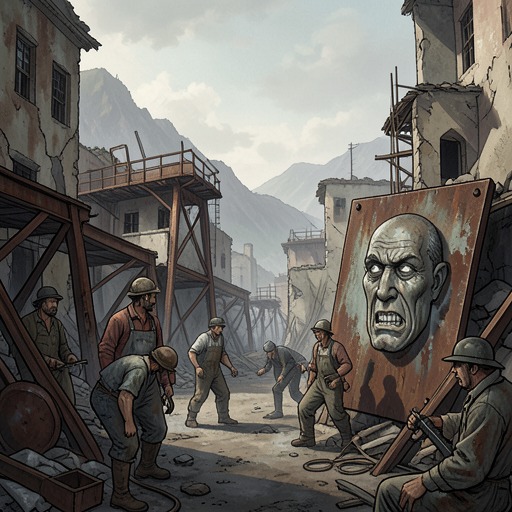
Hacine’s temporary job with Solodia shows a different form of control within the same postindustrial landscape. Solodia has won a Metalor contract to address neglected housing property left behind after the steel mills shut down. The work is expected to last at least three years. Hacine and two or three other workers arrive at buildings with buckets, sledgehammers, and crowbars, first breaking down interiors and then clearing the debris. The physical sequence is specific and collective: one group fills buckets while another carries and empties them into a dump truck, and beams and pipes are shouldered out.
At first, Hacine works at a frantic pace, treating aggression as strength and racing up the stairs because he is anxious to finish. Jacques, who gives the crew its instructions despite earning little more than the other workers, takes him aside and corrects that approach. When Hacine later arrives late, Jacques again intervenes, telling the others to leave him alone and reminding him that work has its own timing. Hacine gradually learns to pace himself by observing Jacques’s routines: cigarettes at eight and ten, coffee with the later break, the radio turned up at eleven for a favored broadcast, heavier effort in the morning, and more restraint in the afternoon. He also notices a weekly rhythm, with greater exertion early in the week.
These habits do not give Hacine control over the conditions of employment, but they create limited room inside time organized by someone else. He recognizes that his time does not belong to him and that work makes his body into an instrument governed by other people’s decisions. Jacques’s rituals offer a practical means of making the workday bearable, not an escape from its structure. The crew’s coordinated labor and Jacques’s protection of Hacine also complicate Patrick’s image of atomized employment: workers remain capable of mutual assistance, even where authority and the need to endure shape their choices.
Factory Targets and Collective Knowledge
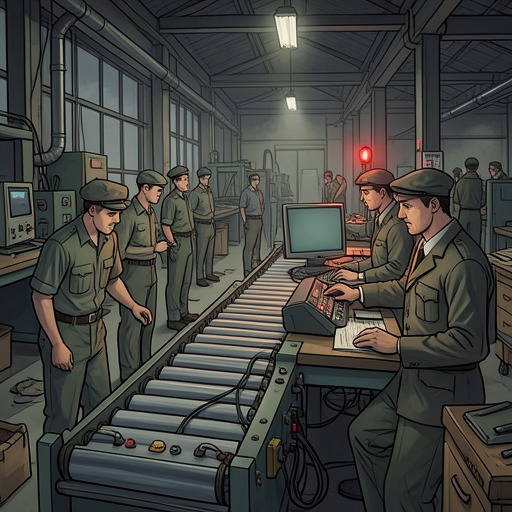
At Gordon, Anthony’s coworkers respond to the production system through a shared but unspoken strategy. The day after France reaches the World Cup final, the workers at the stacking station arrive in an unusually buoyant mood, though the excitement does not make them work faster. They know that exceeding the expected pace risks raising the following month’s targets. Management can tighten production demands incrementally, pairing pressure with a bonus until workers are drawn more deeply into the production system.
Foremen circulate through the workshops looking for downtime, but the workers’ response is not simply to stop. They maintain continuous activity at a studied, economical pace, building in tiny pauses and quietly getting ahead of schedule so that they can ease off later. Their practice depends on shared knowledge: the workers understand the production targets and each other’s rhythms, while managers suspect the strategy but cannot prove it. The resulting mistrust does not erase solidarity; instead, the workers’ common restraint sustains it. The warning against anyone who works too hard reflects a collective defense of the pace against individual overperformance that could invite higher demands for everyone.
Taken together, these workplaces show that corporate discipline operates through several linked methods: recorded stops on Patrick’s route, rules about the company’s image, the supervision of demolition crews, and production targets enforced by foremen. Yet the workers are not portrayed as entirely passive. Patrick sometimes records a visit without restocking a machine, Hacine learns to manage the clock through Jacques’s example, and Anthony’s coworkers collectively limit their pace. These responses do not undo the power of employers to define work, measure performance, or set the terms of employment. They do, however, preserve small areas of discretion and companionship within systems that repeatedly try to make labor individually countable and workers interchangeable.